Hail is a recurring, budgetable risk in Monroe — roughly 3 hail-producing storms in a typical year. The 90-day log below shows where the most recent activity landed relative to town, so you can judge whether your street was in a hail path.
Monroe's Storm-Climate Context
Monroe sits in the humid subtropical belt of northeast Louisiana where roofs absorb punishing heat, rain, and storm stress year-round. Average annual precipitation is 55.10 inches spread across roughly 106 rain days per year, and temperatures exceed 90 F on approximately 91 days annually, with a record high of 109 F. The record low of -2 F in February underscores freeze-thaw risk on the rare cold snaps that reach the region. Tornado threat is real: an EF3 tornado struck on April 12, 2020. The March 2016 flood event dropped 15 to 20 inches of rain over three days area-wide, damaging 9,500 homes in Ouachita Parish alone. High rainfall, UV load, and periodic severe storms make flashing integrity, drainage capacity, and impact-resistant shingles critical priorities.
Monroe had a 2020 census population of 47,702. The local employer base is anchored by the Ouachita Parish School Board (2,844 employees), Lumen Technologies/CenturyLink (2,360), St. Francis Specialty Hospital (1,584), Monroe City Schools (1,348), and Glenwood Regional Medical Center (1,156). The March 2016 flood that damaged 9,500 homes and the April 2020 EF3 tornado created significant storm-restoration demand; the public-sector and healthcare employment base provides economic stability for ongoing residential re-roofing activity.
Hail Events Near Monroe by Date
September 22, 2026 — 1 report, hail up to 1.00″ (quarter size)
| Time (UTC) | Hail size | Location | Distance from Monroe |
|---|---|---|---|
| 2032 | 1.00″ | 4 WNW Sterlington, Union County | 14.5 mi |
Preliminary Local Storm Reports from the NOAA Storm Prediction Center. Sizes are reported hailstone diameters; times are UTC. Reports can be added or corrected for about a day after each event. A quiet page section ≠ no hail — smaller or unreported events happen. The closest report in this window landed 14.5 miles from Monroe's center.
View these 1 report on a map
Circle positions are the NOAA SPC report coordinates; tap a circle for the date and hail size.
Hail size: < 1″ 1–1.75″ ≥ 2″ not recorded
How Severe Was It? The NWS Yardstick, Applied to Monroe's Reports
The National Weather Service calls hail severe at 1″ (quarter size) and significant at 2″ (hen-egg size). Scoring the 1 Monroe-area report (filed in Union County) against that scale: 1 of them met the severe 1″+ criterion — the size at which asphalt shingles start taking granule loss and bruising that shows up as leaks a season later. Damage at these sizes is rarely visible from the ground but is typically covered by homeowners insurance when documented promptly.
What to Do If Your Roof Was in the Hail Path
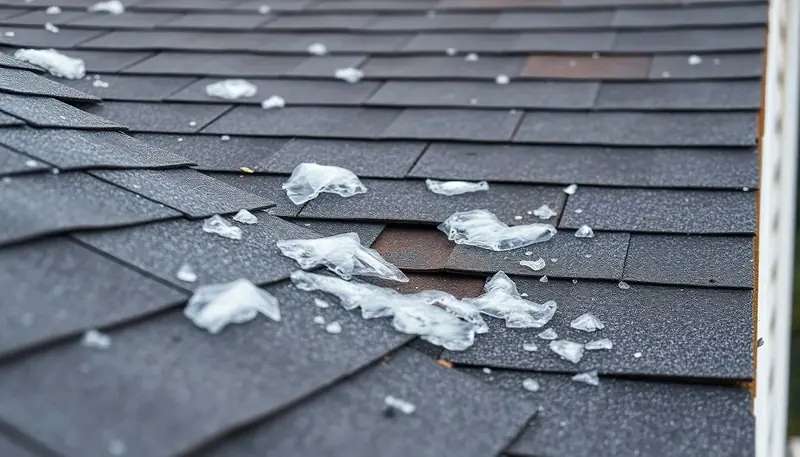
- Stay off the roof and read your yard instead. Granule piles at the downspouts, dings in gutters and window screens, shredded leaves — after the September 22, 2026 activity near Monroe, those ground-level proxies tell you whether the roof took a hit.
- Build the paper trail before anyone touches anything. Dated photos of the damage, a hailstone next to a coin if one is still around, and this NOAA log tying the loss to a specific Monroe storm day are what the adjuster will ask for.
- Expect door-knockers — and slow down. In a hail market like Monroe, out-of-town crews canvass neighborhoods within days of an event. Do not sign a contract or an Assignment of Benefits on the doorstep; get a written inspection scope from a roofer you chose first.
- File on your policy's clock, not the salesman's. Sudden storm damage is generally covered for Louisiana homeowners, and your filing window comes from the policy itself. File promptly while the dates above are fresh, but on your terms.
- Have your contractor at the adjuster meeting. A written scope keeps the estimate honest. Step-by-step: the roof insurance claim guide.
Hail History in Monroe — the 10-Year Picture
The county behind Monroe has logged 39 hail events over the last decade — a pace of roughly 4 per year — with the most severe stone measured at 2.50″. Against that 10-year baseline, the 1 hail day in this 90-day window run above the long-term average rate. Monroe averages 3 hail-producing storms per year — check hail risk lookup for your address.
Monroe's county sits right at the Louisiana median of 40 hail events per county over 10 years — average exposure for the state, meaning the risk is real but not outsized compared with neighboring markets.
Monroe's County, Year by Year (NOAA Archive)
| Year | Recorded hail events | Largest stone |
|---|---|---|
| 2024 | 1 | 1.50″ |
| 2023 busiest largest stone | 11 | 2.50″ |
| 2022 | 3 | 1.00″ |
| 2021 | 7 | 1.25″ |
| 2020 | 4 | 1.75″ |
| 2019 | 4 | 1.75″ |
| 2018 | 1 | 1.75″ |
| 2016 | 8 | 1.75″ |
NOAA Storm Events archive, Monroe's county. Years with no row logged no hail events.
2023 was the county's standout hail year on both counts: the most recorded events (11) and the largest stone (2.50″). Roofs installed before that season have already survived the local worst case — or absorbed damage that was never inspected.
Hail in Monroe — Questions Homeowners Ask
Check Your Own ZIP in Monroe
The county-level history above averages over the whole area. For a score tied to your address, run your ZIP through the hail risk lookup — Monroe ZIP codes include 71203, 71201, 71202, 71224, 71256.
Monroe Neighborhoods — Hail Exposure Varies by Area
Hail paths track with storm cell movement, not city limits. If you're in Downtown Monroe, South Side, River District, West Monroe or Eastside, check your specific street against the report locations above — distance from Monroe's center is listed for each report.
More Resources
Roofing contractors in Monroe · Storm damage repair in Monroe · Insurance claim guide · Roof replacement costs in Monroe · Emergency roof repair