Hail Reports in Toledo, Ohio — Last 90 Days
NOAA Storm Prediction Center logged 3 hail reports within 25 miles of Toledo across 2 storm days, most recently on August 10, 2026. Source: SPC Local Storm Reports (preliminary, may be revised).
Data as of October 24, 2026 (last successful NOAA check). The newest report in the feed is from Oct 23, 2026. The 90-day log is SPC preliminary data. The county history (2017 to June 2026) is the NOAA Storm Events archive, 2014–June 2026; it has no storms after it ends.
- 1.75 inlargest hail near the city, last 90 days (golf ball size)
- 10days with hail 1 in or larger in the county, 2014–June 2026
- 51days with 58+ mph thunderstorm wind, 2014–June 2026
- #158 of 209among the cities we cover, by hail days of 1 in or more
Has hail hit my Toledo roof since it was installed?
County-level hail reports for Toledo from the NOAA archive this page uses; a county report is not proof of damage at your Toledo address.
When does hail hit Toledo?
NOAA NCEI Storm Events, county level, 2014–June 2026
If insurance covers it, what do I pay in Toledo?
Only if the claim is approved. The ACV math is a straight-line example over a 25-year life; insurers writing Toledo policies use their own schedules, so check your policy.
Request Sent!
A local contractor will reach out as soon as they review your request.
Hail near Toledo in the last 90 days
- 1.75 inLargest hail in 90 days (golf-ball size)
- 2Hail days near Toledo
- 3SPC reports
- August 10, 2026Most recent event
Around Toledo, the NOAA Storm Prediction Center logged 3 hail reports within 25 miles between August 9 and August 10, 2026, spread over 2 storm days. Both days brought stones of 1″ or more, and 0 of the 3 Toledo reports with coordinates fell within 10 miles of the city center. In a typical year Toledo sees about 4 hail-producing storms.
Toledo's storm-climate context
Toledo roofs face a wide temperature swing, with a record high of 105 F on July 14, 1936 and a record low of minus 20 F on January 21, 1984. About 37 inches of snow falls per year, adding winter snow load to consider. The city averages lows at or below 0 F on 5.6 nights in January and reaches 90 F or more on 18.8 days in July, so roofing materials endure repeated freeze and heat cycles.
Toledo had a population of 270,871 at the 2020 Census, estimated at 265,638 in 2024. Its metro area is home to four Fortune 500 companies, Dana Holding Corporation, Owens Corning, The Andersons, and Owens Illinois, along with the University of Toledo as the largest college in the city. Cleveland-Cliffs invested 700 million dollars into an East Toledo steel plant completed in 2020 and designed to create over 1,200 jobs.
How close the hail came
On August 10, 2026, a report fell just 11.5 miles from the Toledo city center, the nearest of 3 (1.25″ at 3 E Berkey). August 10, 2026 was the heaviest day around Toledo, with 2 reports and a top stone of 1.75″. Near Toledo, 2 of 2 hail days reached 1″ or larger.
| Distance from city center | Reports | Largest |
|---|---|---|
| Within 5 miles | 0 | — |
| Within 10 miles | 0 | — |
| Within 25 miles | 3 | 1.75″ |
Distances are straight-line from the city center to each SPC report point; reports without coordinates are left out of the table.
Hail events near Toledo by date
August 10, 2026 2 reports, hail up to 1.75″ (golf-ball size) Largest in 90 days
| Time (UTC) | Hail size | Location | Distance from Toledo |
|---|---|---|---|
| 0423 | 1.75″ | Ottawa Lake, Monroe County | 12.0 mi |
| 0420 | 1.25″ | 3 E Berkey, Lucas County | 11.5 mi |
August 9, 2026 1 report, hail up to 1.50″ (ping-pong-ball size)
| Time (UTC) | Hail size | Location | Distance from Toledo |
|---|---|---|---|
| 0003 | 1.50″ | 4 W Whitehouse, Lucas County | 20.2 mi |
The Toledo tables above list preliminary Local Storm Reports from the NOAA Storm Prediction Center. Sizes are reported hailstone diameters; times are UTC. Reports can be added or corrected for about a day after each event. A quiet log does not mean no hail: small or unreported events happen. The closest report in this window landed 11.5 miles from Toledo's center.
View the 3 Toledo-area reports on a map
On the Toledo map, circle positions are the NOAA SPC report coordinates; tap a circle for the date and hail size.
Hail size: < 1″ 1–1.75″ ≥ 2″ not recorded
How severe was it? The NWS yardstick, applied to Toledo's reports
The National Weather Service calls hail severe at 1″ (quarter size) and significant at 2″ (hen-egg size). Scoring Toledo's 3 area reports (filed in Lucas, Monroe Counties) against that scale: 3 of the Toledo reports met the severe 1″+ criterion — the size at which asphalt shingles start taking granule loss and bruising that shows up as leaks a season later. At these sizes, damage on a Toledo roof is rarely visible from the ground, and homeowners policies typically cover it when it is documented promptly.
Hail history in Toledo: the long picture
County-level NOAA records for the county behind Toledo, 2014–June 2026. Each figure shows its source. Storms after the archive ends are not in these numbers. Ranks count from 1, the highest.
Toledo against the 209 cities we cover
- #158of 209Days with hail 1 in or larger in Toledo: bottom quarter
- #175of 209Days with hail 1.75 in or larger (golf ball) in Toledo: bottom quarter
- #95of 209Days with 58+ mph thunderstorm wind in Toledo: middle
- #165of 209Tornadoes in Toledo: bottom quarter
- #148of 209Reported storm property damage in Toledo: middle
- #7of 209Share of homes built before 1980 in Toledo: top quarter
Hail events by year
| 2017 | 4 |
|---|---|
| 2018 | 2 |
| 2019 | 7 |
| 2020 | 4 |
| 2021 | 0 |
| 2022 | 0 |
| 2023 | 5 |
| 2024 | 1 |
| 2025 | 0 |
| 2026* | 6 |
Years with no record show as 0. In its busiest full year (2019) Toledo's county logged 7 events; the whole span, 2017 to June 2026, holds 29.
2026 covers only January to June: NOAA's file ends there, so it is not counted as the worst year or in the yearly average.
Source: NOAA Storm Events Database, county level, 2017–2026Hail history at a glance
- 29Hail events in the county, since 2017 (NOAA)
- 2.50 inLargest hailstone on record
- Mar 26, 2026Last recorded event in the archive
Hail events in Toledo's county, since 2017: 29, or roughly 3 a year, topped by a 2.50″ stone. Set against that baseline, the 2 hail days near Toledo in the 90-day window above run above the long-term average rate. Check your own Toledo address on the hail risk lookup.
Toledo's county sits right at the Ohio median of 28 hail events per county since 2017 — average exposure for the state.
Three ways a storm reaches a roof
Hail
Toledo's county days with at least one report at that size. Largest stone: 2.50 in.
Source: NOAA Storm Events Database, 2014–June 2026Thunderstorm wind
51 Toledo's county days with 58+ mph
58 mph is the NWS severe threshold. Strongest gust on record in Toledo's county: 81 mph on Jul 2, 2019.
Source: NOAA Storm Events Database, 2014–June 2026Tornadoes
3 in Toledo's county
Strongest tornado in Toledo's county: EF2 on the Enhanced Fujita scale.
Source: NOAA Storm Events Database, 2014–June 2026Costliest storm day
Jun 15, 2023
7 reports that day (5 hail, 2 tornado); reported property damage $181,000; county FIPS 39095, 2014–June 2026.
Source: NOAA Storm Events, 2014–June 2026Peak storm month
June
In Toledo's county, 44 of 143 hail, wind and tornado reports (31%) fell in June.
Source: NOAA Storm Events, 2014–June 2026Older homes
84% of Toledo homes built before 1980
About 112,000 of Toledo's 133,195 housing units (share times units, rounded). Median year built: 1955. Housing units, not roofs: many Toledo homes have been re-roofed since.
Source: Census ACS (Toledo city), 2019–2023Year-by-year table with the largest stone
| Year | Recorded hail events | Largest stone |
|---|---|---|
| 2026* | 6 | 1.25″ |
| 2024 | 1 | 0.75″ |
| 2023 largest stone | 5 | 2.50″ |
| 2020 | 4 | 1.00″ |
| 2019 busiest | 7 | 1.50″ |
| 2018 | 2 | 0.88″ |
| 2017 | 4 | 1.00″ |
NOAA Storm Events archive, Toledo's county. Years missing from the table have no record in the archive. * 2026 covers only January to June: NOAA's file ends there, so it is not counted as the worst year or in the yearly average.
In the archive for Toledo's county, 2019 was the busiest hail year (7 recorded events); the largest stone on record, 2.50″, fell in 2023. A Toledo roof older than 2019 with no documented inspection has probably taken at least one unexamined hit.
In a market with repeat hail, impact-resistant Class 4 shingles often pay for themselves through insurer premium discounts — worth discussing with a Toledo roofer if a recent event tips you into a replacement.

Lucas County fact sheet for Toledo homeowners
Housing age, federal disaster declarations and your state's claim deadlines in one place. All three come from public records, county level.
How old are the roofs? Homes in Lucas County by decade built
| pre-1940 | 24.0% |
|---|---|
| 1940s | 7.9% |
| 1950s | 15.3% |
| 1960s | 12.1% |
| 1970s | 13.9% |
| 1980s | 8.1% |
| 1990s | 7.6% |
| 2000s | 6.6% |
| 2010s | 4.0% |
| 2020+ | 0.5% |
200,764 homes, median built in 1962. 73.2% date from before 1980 and 4.5% from 2010 on; 61.7% are owner-occupied. The most common decade is the pre-1940.
Source: U.S. Census Bureau, American Community Survey · data as of ACS 5-yearWhat to do if your roof was in the hail path
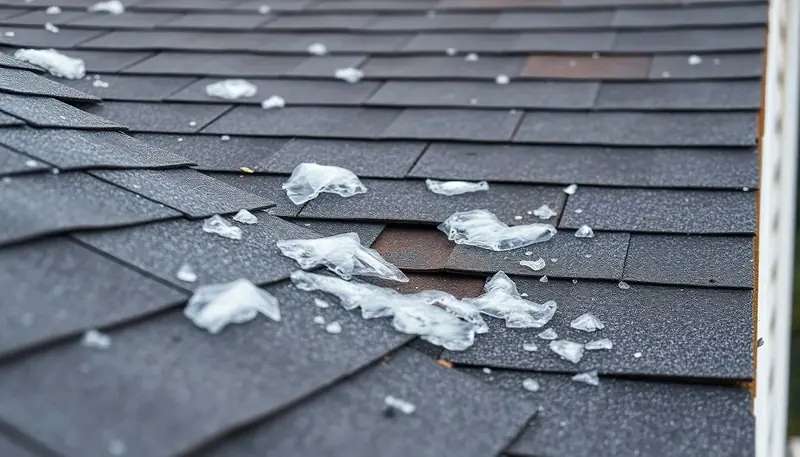
- Read the yard first; stay off the roof. Hail came as near as 11.5 miles to Toledo (3 E Berkey, August 10, 2026) in the last 90 days. Granule piles under a Toledo downspout and dents on gutters, vents and screens are the signs to look for.
- Photograph and date everything before repairs. The log's worst day near Toledo: August 10, 2026, 2 reports, largest 1.75 in. Pair that date with your dated photos and a coin-for-scale shot to pin the loss to a storm.
- Have a roofer look before you decide. 2 of the 2 hail days near Toledo reached 1 inch or more. Nobody on a Toledo lawn can see bruised shingles or lost granules, so a written scope from a roofer is the test for a claim.
- File by your policy's deadline; know the insurer's. Hail last fell near Toledo 76 days ago. The policy sets your reporting window, while Ohio law sets how fast the insurer must answer (page linked below).
- Bring the written scope to the adjuster. Hand over the scope in writing: an adjuster working a Toledo claim then has the contractor's numbers. Step-by-step: the roof insurance claim guide.
Insurer clocks for Toledo homeowners: rule text, quotes and links on the Ohio claim-deadlines page (checked 2026-10-09). Not legal advice.
Hail in Toledo — questions homeowners ask
When did hail last hit Toledo, OH?
How large was the hail near Toledo?
Does homeowners insurance cover hail damage in Toledo?
How often does hail hit the Toledo area?
How close did hail get to Toledo in the last 90 days?
How long does an insurer in Ohio have to respond to a hail claim?
Check your own ZIP in Toledo
The county figures above average over everything inside the county line. For a score tied to your Toledo address, run your ZIP through the hail risk lookup — Toledo ZIP codes include 43615, 43620, 43609, 43618, 43613.
Toledo neighborhoods — hail exposure varies by area
Hail paths track with storm cell movement, not city limits. If you're in Central Toledo, Downtown Toledo, Sylvania, Northwest Toledo or Southwest Toledo, check your specific street against the report locations above — distance from Toledo's center is listed for each report.
Hail alerts for Toledo: join the list
We track NOAA hail reports for Toledo already. Email alerts are not sending yet — leave your address and you'll be on the list when they start. No spam, unsubscribe anytime.
More resources
- Roofing contractors in Toledo
- Storm damage repair in Toledo
- Roof repair in Toledo
- Roof inspection in Toledo
- Insurance claim guide
- Roof replacement costs in Toledo
- Emergency roof repair
- All recent hail reports
- Hail risk lookup
Sources: NOAA Storm Prediction Center Local Storm Reports (last 90 days, preliminary) and the NOAA NCEI Storm Events Database (county of the city, 2014–June 2026); U.S. Census Bureau American Community Survey 5-year estimates (housing). The Storm Events archive used here ends in 2026, so storms between that date and the start of the 90-day log are not shown. How we collect data. Are you a roofer in Toledo? See how requests reach contractors.
How to cite this page
Free to quote with credit, under CC BY 4.0, no permission needed. The numbers are NOAA Storm Prediction Center preliminary reports: unverified, and not confirmed damage to any roof. This is not an official NOAA or NWS product.